
Steven Johnson spent 19 years at the least wage laborer for a Los Angeles transferring firm, lifting heavy furnishings and struggling three hernias alongside the best way.
For the final decade, the 61-year-old has labored as a waiter and as a prepare dinner in fast-paced kitchens.
Now arthritis has swollen his knees. “I attempted to robust it out, icing myself down,” Johnson stated. However he’s needed to reduce to 2 days per week.
Johnson’s revenue final yr: $11,000. As for retirement financial savings, he says: “That might be a giant, fats zero.”
His employers supplied neither pensions nor 401(okay) plans.
Johnson is hardly alone. Some 52% of California’s personal sector workers ages 18 to 64 work for companies which have failed to supply both form of retirement plan, the AARP reported in August.
That’s 7.4 million folks.
Company executives take pleasure in hefty retirement payouts, however over many years corporations have jettisoned defined-benefit pensions that after assured many rank-and-file staff a gradual revenue till demise. Voluntary 401(okay) plans substitute them in some instances however go away hundreds of thousands of staff weak to inventory market downturns. Others are unable to contribute given their low wages.
Amongst low- and middle-income earners, worry of old-age poverty may be significantly acute. Eight in ten Californians who’ve lacked entry to an employer-provided retirement plan make lower than $50,000 a yr.
Though many authorities workers nonetheless get pensions, as do many union members, and a few personal corporations provide 401(okay) plans, widespread inequity has spurred California and a number of other different states to fill the void by enacting state-sponsored retirement applications for the personal sector.
The Golden State initiative, CalSavers, requires companies with out their very own plans to add their worker rosters. CalSavers then enrolls the employees, robotically deducts 5% from payroll checks and deposits it right into a Roth particular person retirement account. Employees can decide out or increase or reduce the quantity they stash away.
“When you think about low wages, the excessive value of dwelling, debt burdens,” CalSavers is probably not “a panacea,” stated Katie Selenski, government director of this system. “However we are able to degree the taking part in subject.”
To date, 384,000 Californians have CalSavers accounts, with belongings of $272 million. Employers with 5 or extra staff had to enroll by June or arrange their very own plans. Employers with one to 5 staff should comply by December 2025.
However this system, launched in 2019, could do little to assist these already near retirement age or those that can’t afford to avoid wasting. Final yr, 1 in 4 Los Angeles-area staff earned $15 an hour or much less — $31,200 a yr in a full-time job — in accordance with the U.S. Bureau of Labor Statistics.
Greater than a 3rd of workers eligible for CalSavers have opted out. One was Johnson, struggling to outlive with arthritic knees and a part-time revenue. He withdrew the $620 in his account. “I wanted the additional cash,” he stated.

Clara Mesa, 60, is a contractor for a corporation that gives in-flight flood and drink for airways at LAX. She worries she gained’t have sufficient financial savings to retire anytime quickly.
(Carolyn Cole / Los Angeles Instances)
For 38 years, Clara Mesa, a single mom, has labored on an meeting line, loading beverage carts at Los Angeles Worldwide Airport. Unable to afford an house, she pays $500 a month to dwell in an Inglewood storage and commutes by bus.
At 60 years previous, standing on her toes all day, the stress will get to her. “The supervisors say hurry up, hurry up,” she stated. “However I solely have two fingers. I’m not an octopus.”
Nonetheless, Mesa, whose wages have progressively risen to $18 an hour, can’t think about how she’s going to afford to retire. She has $20,000 in a 401(okay), however with hire, meals and payments, her financial savings can be gone “within the blink of a watch,” she stated.
Employees like Johnson and Mesa will get Social Safety advantages as soon as they attain retirement age — however they will’t depend on it being sufficient.
“Social Safety is a bedrock,” Nari Rhee, director of UC Berkeley Labor Middle’s Retirement Safety Program, testified at a federal listening to final yr. However “the present common good thing about $1,500 a month is inadequate to cowl fundamental wants for many retirees, given the price of dwelling.”
Fairly than beef up funding by lifting the $147,000 cap on taxed wages, Congress has raised the age to gather full advantages to 67 from 65 — a hardship for blue-collar staff whose jobs are most probably to ivolve bodily stress.
“Thirty years of labor doesn’t add as much as pay for 30-plus years of retirement,” Ramsey Alwin, president and chief government of the Nationwide Council on Growing old, stated at a latest symposium. “As we’re all having fun with the present of longevity, the maths simply doesn’t add up.”
Greater than a 3rd of People in common well being at 65 are more likely to dwell to 90, in accordance with actuarial research. To keep up their way of life over 20 to 25 years of retirement, Californians will want financial savings equal to at the very least seven instances their annual revenue at age 65, a UC Berkeley research discovered.
Kerwin Garin, 64, goes from one gig job to a different, working as a chef for a temp company. He’s on seven medicines “for numerous maladies,” he stated. And he’s suspending a beneficial cardiology appointment till he qualifies for Medicare.
Ought to the Monterey Park resident retire, he estimates that Social Safety advantages, along with a modest 401(okay) and a pension of simply $150 a month from earlier jobs, would possibly cowl about half his bills, together with hire, utilities, pupil loans, automotive funds and veterinary payments for his cat.
“I fear about it on a regular basis,” he stated. “I simply have to preserve working.”
As a lot as attainable, Garin takes the bus to his cafeteria gigs throughout the area to keep away from including to the 83,000 miles on his Chevy Cruze odometer.
His employer, Culinary Staffing Service, has enrolled its 920 staff, greater than 1 / 4 of whom are over 50 years previous, in CalSavers. The cooks, servers and dishwashers, who work shifts at hospitals, universities and sports activities arenas, “are very glad we’re giving them a approach to save cash,” stated Chief Working Officer Jessica Seastead.
The company had not supplied retirement advantages earlier than, she stated, given the executive burden and expense concerned in organising a 401(okay) program.
CalSavers, which doesn’t cost for its service, “holds your hand by the method and makes it straightforward,” she stated. Computerized deductions additionally make saving handy for staff with out the paperwork concerned in signing up for a 401(okay), she stated.
An AARP survey exhibits that People are 15 instances extra more likely to save for retirement after they can accomplish that at work. They’re 20 instances extra doubtless if this system is automated.
CalSavers “is sweet, as a result of most folk don’t lower your expenses,” Garin stated. The 5% subtracted from his paycheck means “I’ll have extra to fall again on.”
Retirement advantages differ extensively by occupation. Sectors with excessive turnover and low wages additionally are likely to fail staff of their previous age. Simply 30% of staff at U.S. eating places and resorts had entry to a plan, 38% of rubbish collectors and sorters and 62% of development staff, in accordance with 2020 census information.
Against this, 86% {of professional} and technical workers had both a 401(okay) or a pension plan.
Latino and Black staff are concentrated in jobs least more likely to provide retirement advantages. “The story of California’s retirement wealth is a narrative of racial inequality,” Rhee wrote in a UC Berkeley Labor Middle report.
Within the Golden State, 64% of Latino workers and 53% of Black workers weren’t lined by a office plan earlier than CalSavers, in accordance with the most recent information. That compares with 44% of Asian staff and 43% of white staff.
In the meantime, tons of of hundreds of California staff with out immigration paperwork don’t qualify for Social Safety. And one other group is usually disregarded of office retirement applications: some 1.4 million self-employed Californians, few of whom contribute to IRAs or reap the benefits of CalSavers’ particular person sign-up possibility. Many work gigs for corporations that sidestep conventional labor protections by claiming their staff are “unbiased contractors” not “workers.”
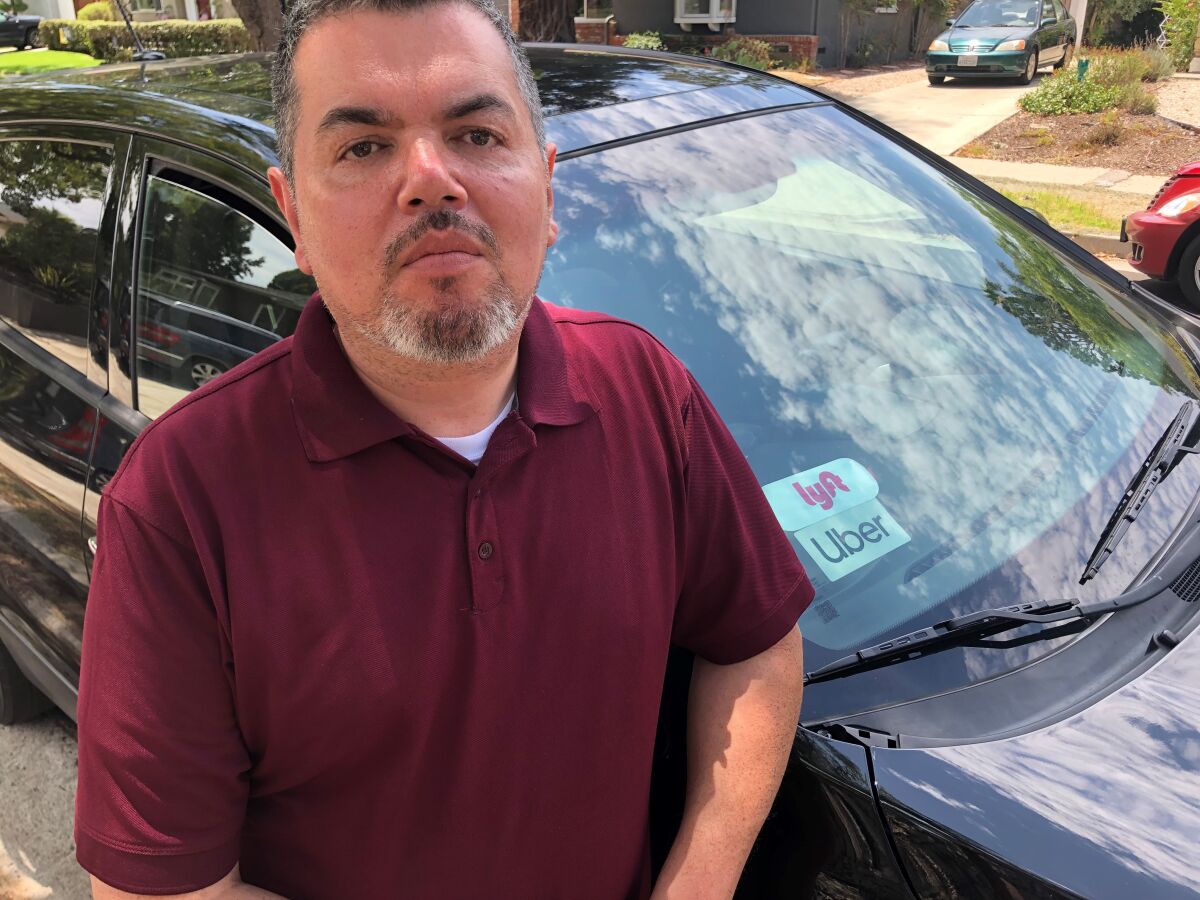
Robert Moreno, 47, drives for Uber and Lyft in San Diego. He worries about retirement as a result of the businesses don’t provide 401(okay) advantages.
(Margot Roosevelt / Los Angeles Instances)
Robert Moreno, 47, drives for Uber and Lyft, touring to San Diego from his trailer dwelling in Potrero, greater than an hour away. He picks up passengers from 11 p.m. Fridays to three a.m. Mondays, taking catnaps in his Honda Tucson between rides.
After fuel, tolls and upkeep, Moreno clears between $30,000 and $40,000 a yr. The remainder of the week, he lives throughout the border in Mexico, the place housing is cheaper and he works along with his spouse constructing a small garment enterprise.
Recently, Moreno has begun to fret about retirement. The ride-hailing giants don’t provide 401(okay)s, nor did Moreno’s earlier jobs at an investigative consultancy and a vacationer company.
“Uber and Lyft are multibillion-dollar corporations,” he stated. “They take greater than half of what my passengers pay. They should handle their staff.”
Uber didn’t reply to a request for remark. In an electronic mail, a Lyft spokesperson wrote: “Lyft drivers are unbiased contractors…. Those that are self-employed can arrange CalSavers accounts to avoid wasting towards retirement.”
Moreno had not heard of CalSavers. As but, the state has performed little advertising and marketing to publicize the choice. About 2,200 self-employed Californians, a tiny fraction of the overall, have enrolled.