
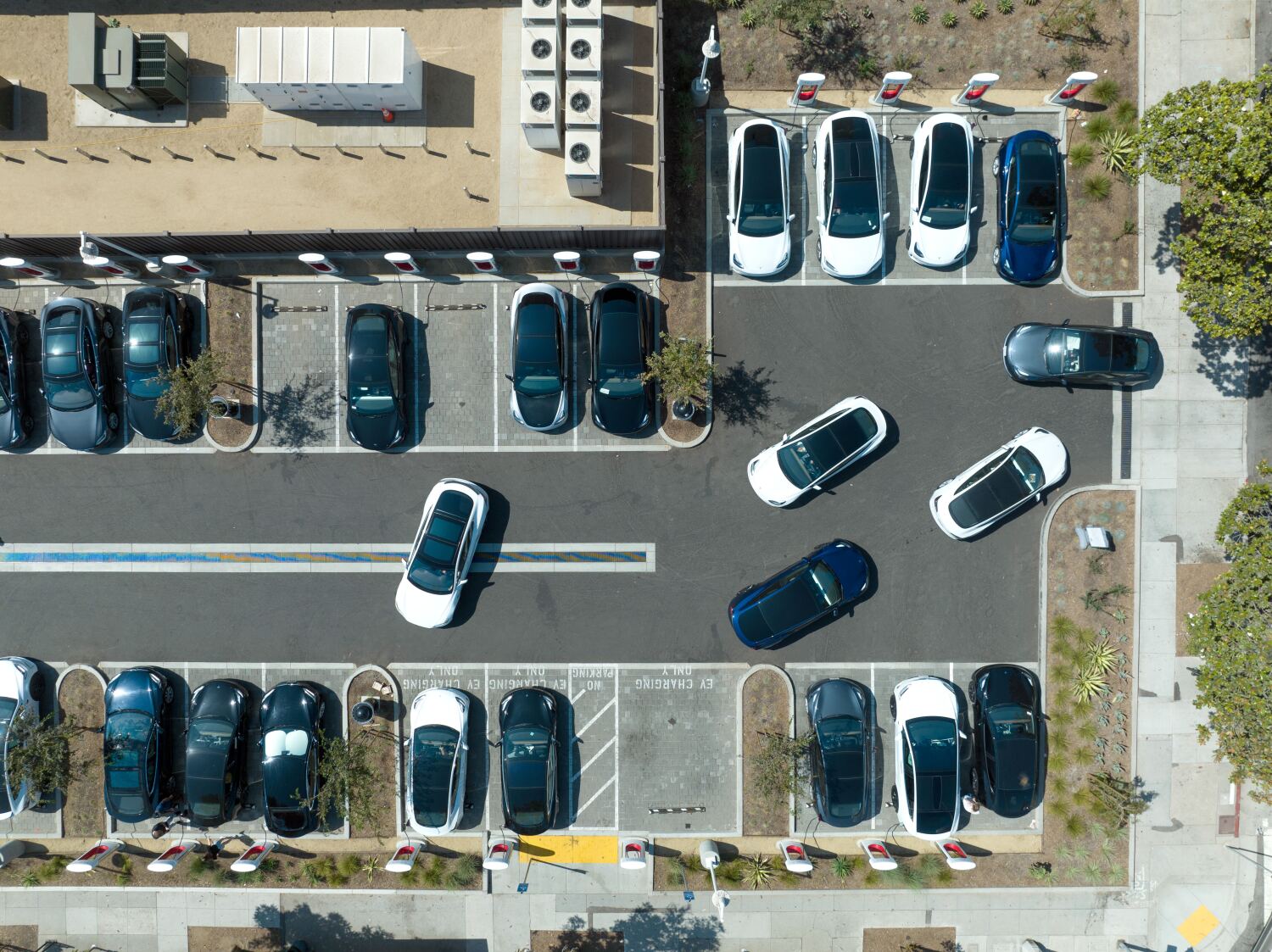
Purchase a automotive in 2035 and also you received’t need to resolve between gasoline, diesel or electrical. You received’t have a selection.
Citing an pressing want to handle local weather change whereas chopping again on air air pollution, the California Air Assets Board voted Thursday to require all new automobiles and light-weight vehicles bought by 2035 to be what it calls zero-emission autos.
Lauren Sanchez, Gov. Gavin Newsom’s local weather advisor, referred to as it “an enormous day not just for California however the whole world.”
The mission, she stated: “Transfer the state away from oil.”
The transfer marks a historic flip within the decades-long battle to curb motorized vehicle air pollution, a momentous shift for customers, business, the economic system and the surroundings.
California has led the nation in auto emissions regulation because the air sources board was created in 1967 to fight the poisonous yellow-brown smog that hung over Los Angeles. The state’s giant inhabitants meant automakers couldn’t ignore California’s mandates. Congress gave California permission to set its personal guidelines a long time in the past, and California’s emissions and gas effectivity guidelines have been adopted by greater than a dozen different states.
Even with that prodigious file, the zero-emission mandate “is crucial and transformative motion that [the air resources board] has ever taken,” stated Dan Sperling, founding director of the Institute of Transportation Research at UC Davis.
The mandate forces automakers to part out gasoline and diesel automobiles, sport utility autos, minivans and pickup vehicles in favor of cleaner variations powered by batteries or gas cells.
If automakers fall brief, they could possibly be charged $20,000 per noncomplying car, the air sources board stated. If customers don’t go alongside? That might trigger large issues. However state officers assume they are going to, and the development line lends confidence.
Electrical automobiles are quickly gaining reputation in California. In 2012, lower than 2% of recent autos bought have been electrical. That grew to 7% in 2018.
However demand has surged since, and now 16% of recent automobiles bought within the state are plug-in autos — battery-electric autos, led by Tesla, plug-in hybrids, plus a smattering of autos that run on hydrogen gas cells. There at the moment are 1.13 million zero-emission autos registered in California, in keeping with the air sources board — 43% of the nation’s whole.
As soon as thought-about little greater than glorified golf carts with paltry vary, electrical automobiles now can journey a number of hundred miles on a single cost, in fashions that vary from small commuter automobiles to luxurious autos to SUVs, pickup vehicles and muscle automobiles.
Beneath the brand new guidelines, 35% of recent automobiles should be zero emission by 2026, 68% by 2030, and 100% by 2035.
Individuals may nonetheless purchase inside combustion automobiles from one other state. However many states, together with most of its neighbors, are inclined to observe California’s lead on car emissions coverage and are contemplating mandates of their very own.
The consequences of the 2035 mandate can be far-reaching, the air sources board stated. It “will primarily finish car emissions altogether,” board Chair Liane Randolph advised reporters.
Not fairly. As Randolph herself famous, homeowners of inside combustion automobiles can proceed to drive them after 2035. It is going to nonetheless be authorized to purchase and promote used fossil-fuel automobiles and light-weight vehicles.
The mandate doesn’t cowl all of freeway transportation, both. Heavy vehicles that burn diesel gas may have 10 further years earlier than they’re banned. A proposed zero-emission mandate for heavy vehicles wouldn’t hit 100% till 2045.
And even the zero-emission car mandate consists of autos that aren’t zero-emission. As much as 20% of a carmaker’s gross sales might be plug-in hybrids, which have each electrical motors and gasoline engines, and nonetheless rely as zero-emission autos, so long as the battery vary is 50 miles or extra.
The state makes use of “zero-emission” as shorthand, pertaining to the automobiles themselves as they transfer alongside the roadways. Recharging the batteries could effectively emit important greenhouse gases, relying on what’s producing the power: coal, oil and pure gasoline on the dirtier facet; photo voltaic, wind, hydropower and nuclear on the cleaner. Creating hydrogen from water for gas cells requires important electrical energy, so greenhouse gasoline emissions once more rely on the supply.
As we speak, 40% of the power generated to be used by Californians is zero-carbon, together with 8.5% from nuclear energy. However the share varies by locality. For instance, whereas coal accounts for less than 2.7% of the state’s whole energy combine, 46% of Anaheim’s electrical energy is produced by burning coal.
Nonetheless, the air sources board’s vote marks a watershed in local weather change coverage.
Newsom ordered motion two years in the past and instructed the board to create an in depth plan. After a number of public hearings and testimony from tons of of individuals and corporations, the Thursday vote makes it official state coverage. The U.S. Environmental Safety Company should grant the state a waiver to set its personal vehicle emissions insurance policies beneath the federal Clear Air Act, a probable slam-dunk beneath the Biden administration.
In keeping with air high quality officers, the brand new laws would scale back greenhouse gasoline emissions from automobiles by greater than 50% by 2040, in contrast with if no motion have been taken. Tailpipe emissions are the main supply of carbon dioxide in California and accounted for about 40% of the state’s greenhouse gasoline emissions in 2019.
Moreover, state officers say the plan would reduce smog-forming nitrogen oxides by greater than 25% in 2037. They estimate the rule will lead to over 1,400 fewer deaths from coronary heart illness, and assist Californians keep away from greater than 700 emergency room visits for bronchial asthma between 2026 and 2040.
Automakers have taken completely different positions on the mandate, starting from enthusiastic to lukewarm to outright opposition.
Ford, which not too long ago launched its F-150 Lightning all-electric pickup truck, has labored intently with the air sources board.
In an announcement, the automaker stated that “combatting local weather change is a strategic precedence” and that the corporate is “happy with our partnership with California for stronger car emissions requirements, solid throughout a time when local weather motion was beneath assault.”
Toyota, which had positioned large bets on its hybrid autos and lagged on pure-electric improvement, relented on its opposition and earlier this week despatched the air sources board a letter recognizing its authority to set car emission requirements. The corporate had sided with the Trump administration on car emissions points.
Some environmental teams stated the mandate doesn’t go far sufficient. Regina Hsu, a senior affiliate lawyer for Earthjustice, famous that international locations together with Norway and the Netherlands have extra bold timelines, and even Washington state has a plan to part out new gasoline autos by 2030, though Gov. Jay Inslee’s dedication is nonbinding.
“The ramp that we see will not be as stringent because it could possibly be,” Hsu stated. “Primarily based on automaker projections, this rule will not be that bold.”
However the transition to electrical autos received’t be simple, and big uncertainties stay.
Value is one. An electrical car nonetheless prices way over an equal gasoline car. In keeping with Kelley Blue E book, the common EV bought for $66,000 in July, in contrast with $48,000 for the common inside combustion car.
In a presentation to reporters, air sources board officers pointed to research that present financial savings in gas and upkeep could make an EV a greater monetary deal over time, and that costs would proceed to drop.
That’s not sure, nonetheless. Provide chain snags and shortages of essential battery supplies reminiscent of lithium and cobalt have reduce EV availability whereas boosting buy worth.
As EV prices stay excessive, green-oriented politicians really feel strain to supply incentives. The $369-billion local weather bundle not too long ago handed by Congress accommodates a major enhance in EV subsidies, together with novel incentives on used automobiles.
Charging is one other challenge. Whereas householders can set up their very own EV charger in a storage, most individuals who stay in condominium buildings and condos don’t have that choice. The state plans to require multifamily housing landlords to supply some strategy to cost electrical automobiles, however the particulars are nonetheless being labored out.
Final yr’s federal infrastructure laws included billions of {dollars} for public fast-chargers to be put in at common intervals on interstate highways.
As a part of the California mandate, the state would require particular ranges of guarantee safety for EV batteries and associated elements. In keeping with Randolph, that won’t solely defend new automotive patrons but additionally assist be sure that dependable used EVs will develop into obtainable.
“We perceive that not everybody should purchase a brand new automotive,” she stated, stating a number of current state packages that provide monetary assist for lower-income prospects to purchase EVs.
Brian Maas, president of the California New Automotive Sellers Assn., which represents greater than 1,200 franchised new automotive and truck vendor members, stated the group is “all-in” on the transition to zero-emission autos.
“We simply wish to ensure that as we proceed alongside this path, we’re all working collectively to reply all these questions,” he stated.
The largest problem could possibly be buyer acceptance on the 100% stage. What occurs if automakers can’t coax sufficient prospects to purchase?
Stated Jennifer Gress, head of the Sustainable Transportation and Communities Division on the air sources board: “We all the time reserve the correct to amend the laws at any level.”
Occasions employees author Tony Briscoe contributed to this report.